◉
Name what a camera could capture.
What was said, when it happened, who was there, what changed? “They cancelled twice” belongs here. “They secretly resent me” does not.
FIELD GUIDE 001 THINKING WITH LESS CERTAINTY
A reply comes late. A room goes quiet. A name disappears from a slide. Between what happened and what you believe it means, there is a space worth examining.
Explore 16 fictional moments. Separate observations from inferences. Consider competing explanations. Respond without pretending to read minds.
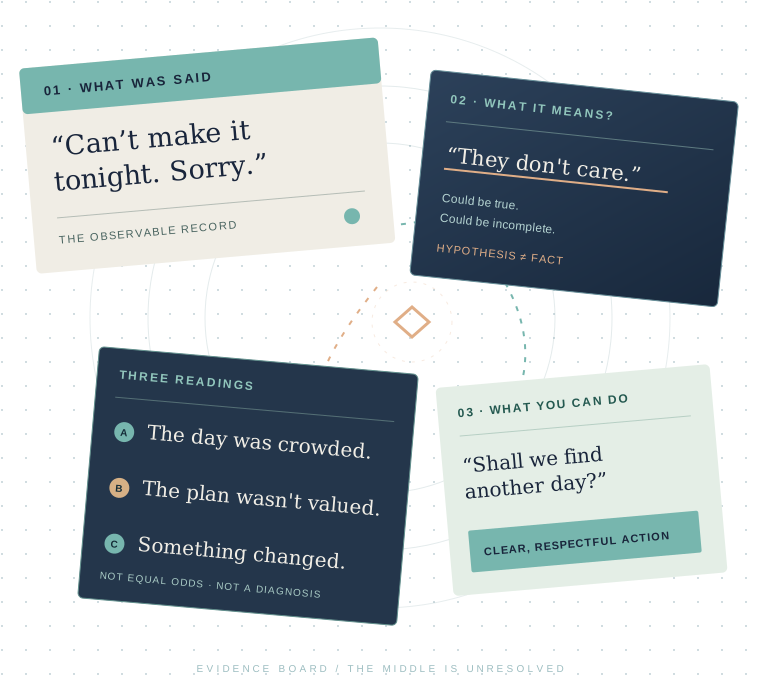
01 / START HERE
A useful interpretation does not demand that you distrust your feelings. It asks you to stop turning an experience into certainty about another person’s interior life.
What was said, when it happened, who was there, what changed? “They cancelled twice” belongs here. “They secretly resent me” does not.
Generate a few plausible alternatives, including uncomfortable ones. Ask what evidence each predicts. Do not flatten strong evidence into artificial ambiguity.
Ask a proportionate question, set a boundary, make a practical request, or leave something alone. You can make a sound decision without final access to a motive.
“I felt dismissed” reports an experience. “They wanted to dismiss me” attributes an intent. Your feeling can be valid even when your interpretation is uncertain. And you are still allowed to set a boundary.
02 / THE ARGUMENT
Not a licence to excuse harm.
Not a demand to be naïve.
Humans make fast social predictions because relationships require them. A late reply can mean “busy,” “uncertain,” “not interested,” or something else. The trouble begins when the first explanation that comes to mind feels like the event itself. Our story can become so vivid that we start arguing with a person we have not actually asked.
The opposite error is possible, too. If somebody repeatedly misses commitments, the pattern is information. You do not need to uncover their secret motives before changing what you agree to. When someone explicitly declines contact, there is no puzzle to solve: respect the refusal. Curiosity should sharpen judgment, not dissolve evidence.
Think of this as a small epistemic pause: first, what could an observer verify? Second, what hypotheses fit? Third, what would distinguish among them? Finally, which response protects dignity, consent, time and agency even if the hypothesis remains unresolved?
You can be uncertain about why something happened and certain about what you will do next.
03 / THE INTERACTIVE DESK
Choose a fictional case. Make a reading. Then test what you know.
Friendship
Loading the scene…
Observation = directly described event. Inference = an explanation added to that event.
Try one observable event, not another guess about personality.
PRIVATE BY DESIGN: your workbench notes exist only in memory in this tab. They are never sent to a server or saved between reloads. Use the export control in the composer below if you want a copy.
04 / DECISION PATH
There is no universal script. Start by asking whether the available evidence already settles a boundary.
05 / THE CONVERSATION STUDIO
Translate a guess about motives into what you observed, what you want to clarify, and what you can respectfully choose. This is a writing aid, not a message service.
“You always ignore me because you think I’m irrelevant.”
TO“I sent two project questions and haven’t heard back. Could you let me know by Friday whether you can review them?”
Nothing is uploaded, emailed or stored across reloads. Avoid identifying private people in notes. “Clear private notes” removes all text and in-tab reflections.
06 / FICTIONAL CASE ARCHIVE
Every case includes facts, three plausible readings, missing evidence, power dynamics, a boundary and a workable response. The full archive works without JavaScript.
No matching cases. Try another term or choose “All contexts.”
A friend posts a photograph from dinner with four people you know. You were not invited. The caption reads “needed this.” You last met the friend two weeks ago, and nothing openly hostile happened.
“They deliberately left me out because they no longer value me.”
A photograph cannot establish a hidden campaign against you.
Who organised the dinner, whether it was an open invitation, and the wider pattern of mutual effort.
Group norms can make a single member feel replaceable. Popularity is not proof of anyone’s intent, but it changes the emotional cost of asking.
You can ask for inclusion or invest in other friendships. You cannot demand an invitation to every private gathering.
“I saw the dinner photo and realised I’ve missed catching up. Want to plan something next week?”
A friend accepts two separate plans and cancels both on the day. Each time they apologise; neither time do they suggest an alternative. You have travelled toward the meeting point once.
“They are selfish and do not care about my time.”
Repeated cancellations are evidence of unreliability in this context; they are not a complete personality diagnosis.
Reasons for each cancellation, their current capacity, and whether the pattern extends to other commitments.
Travel and planning costs have fallen mostly on you. Unequal costs warrant a practical boundary even if motives stay unknown.
Do not prepay or travel for another plan without a firm confirmation. You may pause initiating.
“I enjoy seeing you, but last-minute cancellations have cost me time. I’d prefer you suggest a day when you’re sure.”
At a gathering, a friend imitates your presentation style. Two people laugh. You go quiet. Later the friend texts a meme but does not mention the joke.
“They enjoy humiliating me in front of people.”
Impact is observable and actionable; claimed private enjoyment of humiliation is not.
The friend’s stated intent, prior history of similar jokes, and how they respond when told it hurt.
Public humour recruits an audience; the target may feel pressure to laugh along to avoid seeming difficult.
You can say a topic is off-limits regardless of whether the joker meant harm.
“That imitation at dinner embarrassed me. Please don’t use my presentation style as a joke in groups.”
You sent a colleague a chart for a joint presentation. The final deck includes it, but only the colleague’s name appears on the title slide. There was no prior agreement about credit format.
“They stole my work to advance themselves.”
An omitted credit is a concrete problem; motive remains unproven.
The organisation’s authorship norms, the edit history, and the colleague’s response to a correction.
Visibility shapes promotion and recognition. A junior collaborator may face real costs from challenging a senior presenter.
Protect contribution records and use the appropriate project lead if a direct, safe correction fails.
“I noticed the chart I made is in the deck. Can we add a credit in the slide notes and agree on attribution for the next version?”
You share a six-page draft with a collaborator and ask for comments by Thursday. They react with a thumbs-up on Monday, then say nothing by Friday. The deadline was suggested, not jointly agreed.
“They secretly dislike the work and are avoiding telling me.”
A reaction emoji is not a review commitment.
Whether the person accepted the deadline, their current workload, and what kind of feedback they feel able to provide.
If one person controls publication or approval, an unanswered draft creates bottlenecks beyond emotional uncertainty.
Set a decision deadline you control and proceed with a clearly communicated fallback.
“Could you confirm whether you can review section two by Tuesday? If not, I’ll proceed with the current draft.”
A project partner approves a three-page outline. After the first draft, they request five new sections and call the document “incomplete.” The added sections were not in the original outline.
“They are trying to control me by making success impossible.”
Scope creep may be demonstrable without claiming a secret plan to dominate.
The meaning of approval, whether new requirements are essential, and project authority over scope changes.
The person who approves the deliverable may control payment or evaluation. Use written agreements rather than guessing motive.
Offer a revised scope, timeline, or price before absorbing large changes.
“Those five sections are new relative to the approved outline. I can include them if we revise the schedule and scope together.”
After a pleasant coffee date, the other person says “we should do this again.” You suggest Saturday. They reply “this week is hectic” without proposing another day.
“They are playing games to make me chase them.”
Warmth is not consent to future contact or proof of strategic manipulation.
Their actual preferences, schedule, and whether they later initiate without prompting.
Romantic ambiguity can tempt repeated pursuit. Neither party owes access, explanations, or another date.
One invitation is sufficient. Stop if interest is not reciprocated.
“No worries. If you’d like to meet again, let me know a day that works for you.”
You ask someone on a date. They respond: “Thank you, but I don’t want to date you. Please don’t ask me again.” They later smile and say hello when you cross paths.
“The smile means they secretly changed their mind.”
An explicit no rules out treating later courtesy as permission to pursue. These three interpretations concern courtesy, not hidden consent.
The meaning of the smile is unknown and irrelevant to whether the refusal should be respected.
Pressure after an explicit refusal can turn a social setting into an unsafe one. Consent and autonomy override speculative romantic narratives.
Do not ask again or recruit others to revisit the answer.
“Understood. Thanks for being clear. I won’t ask again.”
Someone you have been seeing for three weeks replies two days after you ask how their exam went. Their message answers the question warmly and asks about your week.
“The delay proves they are losing interest.”
Response time is behaviour; a verdict about affection is interpretation.
Their usual communication rhythm, current demands, and pattern of in-person consistency.
One person’s preferred pace should not become the universal rule. Both can name needs and decide compatibility.
You may prefer a more responsive relationship; express that without monitoring or interrogating.
“I enjoy staying in touch. What kind of texting pace feels comfortable to you?”
You share that you are considering a career change. A parent asks whether the car insurance was renewed, then continues talking about household expenses. They do not comment on your plans.
“They do not believe I can succeed and want to diminish me.”
A subject change shows low engagement in that moment, not the parent’s full theory of your worth.
Whether the parent heard the full point, their actual view, and whether this is a recurring family pattern.
Dependence, money and age hierarchies can affect who feels free to disagree. Safety and autonomy matter more than extracting approval.
You can request attention and also choose where to seek encouragement.
“I know practical details matter. Could we spend ten minutes on the career decision? I’d like to hear your concerns.”
A sibling says they will attend your small ceremony, then messages 30 minutes beforehand saying they cannot make it. They congratulate you later. You had reserved them a seat.
“My milestones do not matter to them.”
A failed commitment is meaningful evidence about an event, not a measurement of lifelong love.
The reason for cancellation, how clearly the event’s importance was conveyed, and longer-term reliability.
Family loyalty narratives may pressure people into promises they cannot fulfil, and may also silence legitimate disappointment.
Future invitations can be offered without reserving costly resources until confirmed.
“I was disappointed because I saved you a seat and wanted you there. Next time, please tell me as soon as you know you can’t come.”
A supervisor returns a report with the comment “Needs work.” The rest of the file has no annotations. It is the first report you have submitted in the role.
“My supervisor thinks I am incompetent.”
Vague feedback may be poor management practice without revealing a global verdict on you.
What needs changing, the quality bar, deadline, and feedback culture of the team.
Supervisors influence evaluations. Requesting actionable criteria is reasonable; escalating may require attention to organisational dynamics.
Seek clear standards and document requests; do not accept an unbounded obligation to guess.
“Could you point me to the two highest-priority changes and an example of the expected format?”
During three remote meetings, a colleague keeps their camera off. They contribute clearly in chat and deliver the assigned work on time.
“They are disengaged and disrespectful to the team.”
The observed on-time work is contrary evidence to a simple claim of disengagement.
Any genuine requirement for video, accessibility considerations, and established team norms.
Camera mandates can expose private spaces and create disproportionate burdens. Visibility is not a proxy for performance.
Ask for participation in agreed forms, not disclosure of private surroundings.
“For the workshop exercise, would speaking or the shared whiteboard work for you? Video isn’t necessary.”
An important project decision happens in a meeting you did not attend. You were not on the invitation. The decision affects a task you own, and nobody sent a written summary.
“Leadership deliberately wants to undermine me.”
An unfair process can be challenged on its merits without knowing anyone’s internal reasons.
Who set the meeting, relevant inclusion criteria, and whether this happened repeatedly.
Exclusion from decision-making can materially limit ownership and advancement; accurate records matter even without a motive verdict.
Do not accept accountability for unseen changes without requesting a record and new scope.
“I own the affected task. Please send the decision notes and include me when this scope is discussed again.”
After a friend says they are having a difficult week, you send “thinking of you; no need to reply.” The app shows no read receipt for four days.
“They are deliberately ignoring my kindness.”
An unread marker is app metadata, not evidence of ingratitude.
Whether the message was seen, their present capacity, and their contact preferences.
Support can become pressure if the sender demands recognition for offering it. Caring may require tolerating silence.
Do not convert a no-reply message into repeated demands for acknowledgement.
No response is required now. If there is a concrete safety concern, seek appropriate immediate assistance rather than interpreting read receipts.
During a group conversation about a controversial subject, one participant listens, nods occasionally, and says nothing. Afterward they thank the facilitator for the discussion.
“They agreed with the loudest speaker but lacked courage to admit it.”
Nodding and thanks do not prove political agreement.
Their actual view, safety considerations, and whether they wanted a speaking turn.
Dominant voices and group status can suppress participation. Silence is not consent, agreement or confession.
Participation is voluntary unless a fair, explicitly agreed role requires an answer; nobody owes a public personal revelation.
“Thanks for joining. If you ever want to add a thought later, you’re welcome, but there’s no pressure.”
07 / WHAT RESEARCH CAN & CANNOT SAY
These are research-informed distinctions. They do not validate this particular interface or guarantee that a chosen response will work.
We sometimes explain behaviour as stable character even when circumstances could account for it. Correspondence bias is not proof that every attribution is wrong. It tells us to check for context before declaring a personality verdict.
Gilbert & Malone (1995) ↗People often begin from their own perspective and adjust incompletely. We may think we know how our words landed or why someone acted, when we are partly projecting our own view.
Epley et al. (2004) ↗Once we form a theory, supporting details become salient while disconfirming details get less attention. Ask what you would need to see to revise a claim. A good hypothesis can lose.
Nickerson (1998) ↗Intuitive predictions can neglect prior frequencies in favour of a vivid match. In actual relationships, relevant base rates are rarely measured for the individual. Do not invent percentages for someone’s intent.
Kahneman & Tversky (1973) ↗Memorable stories may be easier to retrieve than ordinary ones. The availability heuristic helps explain why one striking past experience can colour interpretations of a new person.
Tversky & Kahneman (1973) ↗Where sexual consent is relevant, it must be voluntary, clear and ongoing. The wider principle here is respect for stated boundaries; we do not equate the legal or ethical specifics of sexual consent with every social interaction.
RAINN consent guidance ↗Research distinguishes relationships based on meeting one another’s needs from relationships built around a direct exchange. “Mutual” does not always mean counting identical gestures. Notice care and follow-through without turning a friendship into a ledger.
Clark & Mills (1979) ↗Research on intimacy highlights disclosure and perceived partner responsiveness in interactions. Neither constant contact nor a single enthusiastic message proves closeness; context and repeated exchanges matter.
Laurenceau et al. (1998) ↗A TENSION WORTH HOLDING
Context matters. A missed meeting can be an oversight.
Patterns matter. Repeatedly missed meetings still impose costs.
Consent matters. “No” is not uncertainty to be optimised away.
08 / PRACTISE WITHOUT A SCREEN
Write one column headed “camera or recording” and another headed “my explanation.” Move every motive word into the second column. Notice how much remains useful in the first.
Good for: heated moments and confusing messages.Before chasing another clue, finish the sentence “I would revise this story if…” Name an event that could really occur. If nothing counts, you may be defending a belief rather than testing one.
Good for: repeated rumination and entrenched stories.If the same behaviour came from someone with a new baby, a busy shift, or a different communication style, would you explain it differently? Then check whether the alternate context is actually supported.
Good for: correspondence bias without reflexive excuse-making.Ask, “Even if my least threatening explanation is true, what boundary do I still need?” A person may be overloaded and still unable to meet your project deadline. You can care and change the plan.
Good for: making decisions without motive certainty.09 / THE LIMITS
This site offers original fictional exercises informed by psychology; the exercises themselves have not been empirically tested or clinically validated. It does not score accuracy, infer anyone’s mental state or diagnose a cognitive pattern. The content is educational, not a substitute for professional support or workplace advice.
Some behaviour has direct implications without a full account of motive. Harassment, coercion, discrimination, threats and clear refusals must not be dissolved into a “maybe they meant well” exercise. When safety, authority or exploitation is at stake, practical documentation and appropriate support may matter more than another conversation.
Research findings come from particular methods, times and populations. Applying them to an individual relationship is interpretive judgment, not a scientific measurement. Some sources below are behind publisher paywalls; bibliographic details and abstracts are verifiable.
10 / A POCKET GLOSSARY
An event, action or statement a careful witness could describe without explaining intent.
A conclusion drawn from available evidence, useful but revisable.
An explanation for behaviour, such as a personal trait or situational constraint.
Everyday shorthand for assuming access to another person’s private thoughts; not a diagnosis.
A frequency in a relevant reference group; usually unknown for one person’s private motives.
Mutual contribution over time—attention, effort, responsiveness—not a demand for perfectly symmetric gestures.
Voluntary permission in a relevant context; explicit refusals and withdrawn permission require respect.
A limit on what you will agree to, initiate, tolerate or continue, regardless of guessed intent.
11 / RESEARCH NOTES
Direct links to originals and institutional guidance. The short descriptions are editorial interpretations of the cited work, not quotations.
Review of why people infer stable dispositions from situationally explained behaviour.
Experimental results on anchoring perspective judgments in one’s own view.
Review of the tendency to seek and interpret evidence in favour of existing beliefs.
Classic studies showing how intuitive predictions may neglect prior probability.
Foundational account of how easy recall affects probability judgment.
Plain-language guidance specifically concerning consent to sexual activity; used only within that context.
Experiments distinguishing norms of reciprocation in communal and exchange relationships.
Event-contingent diary studies of disclosure, responsiveness and felt intimacy.
THE QUESTION TO TAKE WITH YOU
Perhaps a clearer question. Perhaps a firmer boundary. Perhaps simply a little more room for another human to be human.
Your email application will open; this website will not send a message for you.